3/7/09

Sucre to Arequipa

So there is a bit of a gap of photos in this update. I'd like to show you how beautiful La Paz was or Sucre, Bolivia's second city, but unfortunately some pickpocket decided he'd prefer to have those photos, and the camera they were taken with. But, a quick trip to the black market in La Paz and I'm back on track.

Sucre was a strangely wealthy city surrounded by a country that doesn't have enough money to properly feed itself. With a politically left stance, an attitude that it should be the real capital of Bolivia, not La Paz (President Morales moved all the judicial decisions to La Paz when he was elected) and a bit of an inferiority complex it makes for an interesting experience when compared against the rest of the country. A bit like Cork then...

Sucre was a comfortably welcome break while we beat off a brief second bout of sickness. Our medicine was provided by an unashamedly Gringo bar/restaurant called Joy-Ride situated off the main square. Lots of "normal" food, yay! Noodle soup, nachos, spagetti bologonese. At night it came alive with backpackers and wealthy Sucre yuppies with Daddy's drug money.

Another of Sucre's attractions is real live (dead) dinosaur footprints! Quite some time before the Incas were stomping around building roads and eating llamas, dinosaurs were stomping size 200 footprints and eating each other. Every so often they would step in molten lava (probably just the once) and their imprints were saved so that millions of years later a Bolivian tourism student could pay his way through college by showing them to Irish backpackers.
Initially suspicious, I was even more so when I saw a picture of them in a brochure. I'm no Ross Geller when it comes to dinosaurs but I'm pretty sure they never climbed vertically up walls... Apparently, the explanation was that these ones didn't either but rather that tectonic action............. wait! don't fall asleep!........ earthquakes, God, whatever, pushed rock up, eventually making horizontal stuff vertical. In the end they turned out to be pretty interesting. We hiked up along a river for an hour, passing locals washing their clothes, cars and kids in the water before arriving at a cliff that looked like a 5 dinosaurs had a brawl. HUGE prints were detailed enough to show the direction they were walking and even what type they were, very cool.

Well sick of Bolivian buses and roads by this stage we decided to treat ourselves to a flight to La Paz, Bolivia's capital. Andreas and Aynur accompanied us on the quickest flight and checkin procedure I've ever had. Security consisted of a guy in a t-shirt lazily peering into hand luggage as it was presented to him by each passenger. I'd say if I had a bag with "explosives" written on the side he'd have waved me on just so he could go back to his newspaper quicker.
A 20 minute spin in a half empty plane dopped us onto the runway of the world's highest airport. At 3800m, and with half the air that exists at sea-level the runway in La Paz needs 3km to allow planes to slow down safely. A scenic taxi drive displays the stubborn sprawl of the city as it wedges itself between huge mountains on all sides. I think the taxi driver probably spotted us gawking out the window and pulled over to allow us to take some photos. I'm hoping my camera thief might upload them flickr at some stage, but for now you'll just have to search for images on google to believe me...

Our timing for La Paz was to catch Carnaval. South America's biggest celebration, its a bit like Paddy's day times ten. Shops, restaurants, everything shuts down for parades and lots
of drinking. Kids run around with bags of water balloons and cans of shaving foam. No one is safe. "There's a Gringo, GET HIM!" "There's an old lady who can barely walk, GET HER!"
I'm not sure at what point in the Bible Jesus ran around spraying the Apostles with shaving foam but it must be there as Carnaval is supposedly a religious celebration. I guess its similar to us celebrating the lack of snakes in Ireland on Paddy's day by spraying take-away food on O'Connell street after 12 pints.

The best place to enjoy Carnaval in Bolivia is a town called Oruro. After asking around about accomodation during Carnaval there and getting laughed at back in Sucre (apparently you need to book months in advance) we opted to do an early morning bus, spend the day, and get the "nite-link" home. A package was offered for this in our hostel so we packed our water pistols and headed off. Carnaval in Ororu is celebrated by people in funny costumes dancing down a main street for 16 hours, after a while the novelty wears off. It was payback time for the kids with the water balloons though. At the start you feel you're doing the right thing by not throwing a water balloon back at the 7 year old that just soaked you, but that novelty wears off too.... We got back late that night, drenched having no clue what the point of Carnaval was exactly.

Our last stop was in Bolivia was Lake Titicaca. Often claimed to be the highest navigable lake in the world, it turns out that's a bit of lie (it isn't even the highest in South America). Nevertheless its nice spot. Isla del Sol is the main draw, an island about 90 minutes from our hostel in Copacabana by boat. With almost 200 Inca ruins its a great spot to wander about for a day. Choosing the option that would let me and Karen sleep in for the morning we went the half-day choice. There haven't been too many days we've wasted on this holiday but the "visit" to Isla del Sol was one of them. Setting off at lunch on a few planks of wood with a motor attached the "ferry" was slower than Bolivian restaurant service. I think ducks swam past us a few times. Finally arriving to the island we were told to be back in 40 minutes! Barely making up the first hill after 20 minutes we needed to turn back. After another 90 minutes back (I swear we went backwards at times, the coast seemed to get further away the more I watched it) we were back on land looking up Isla del Sol on Google to see what we had missed. Oh well.

Border crossings are dodgy experiences at the best of times, in South America, even more so. We hopped on our bus for Arequipa (our first stop in Peru) and then hopped off 10 minutes later to cross the border. The border consisted of a gate that you kind of pushed open yourself, no one supervising. Karen (seemingly eager) was 1st in the queue and got her passport stamped. Next up an American couple you who the border guard seemed to take an instant dislike of and demanded $180 from both of them (some sort of Visa charge but I'm gussing he just need new wheels for his car). Standing to one side while everyone else filed past they pretended to search their bags for the cash obvious to me they weren't carrying it. Meeting up with Karen outside we skipped into Peru and onto the bus, glad to be Irish (US citizens always have a tough time crossing South American borders) and eyeing up the free seats beside us the yanks would not be filling. As the engine started they appeared, breathless but evidently not in jail. Apparently as he passport office emptied of witnesses they managed to bribe the guard with $50 which he begrudgingly accepted and kicked them out the door. I sat back into my seat thinking how, for once, we had a straightforward experience with South American procedure. Or so we thought....

After 6 hours of driving through some of the crappiest looking towns I've ever seen we arrived to Arequipa pleasantly susprised with what we saw of the city centre. We headed to hostel (recommended by Dee and Dave) and ordered some Dominos pizza to quiet the rumbling bellies. Arequipa is a great launch spot to visit the Colca Canyon. Bigger than the Grand Canyon it offers treks, white water rafting and beautiful views of Inca terraces still used today for agriculture. An overnight bus trip provided us with plenty of great photos and a really enjoyable couple of days.

Back in Arequipa we visited another of Dave and Dee's suggestions; Santa Catalina Monastery. Good call Dave. This was a lovely, almost town-like, secluded place of worship over the last 500 years now open to the public. Beautifully restored to give a true insight into the spartan existence of the resident nuns it presented a stark example of the role of Catholicism in South America and the dedication of those who wished to devote their lives to God.

Back to the hostel that evening we packed our bags again, looking ahead to one of the highlights of the holiday; Machu Picchu and the Lares trek!

PS. Two last acknowledgments: Thanks to Karen's mom for checking the photos we sent back, reassuring to know we have backups of what we lost (and that they survived a spin in the DVD player).

Also quick word on Karen's brother, Stephen, who is into the last 5 of the Empire Online short film contest. Register and vote for him here. His film is Jerry Maguire.


2/28/09

Things I've learned about Bolivia

There's a few things I've noticed about the countries we've visited that I never really mention and if I don't write them down I'll probably forget.

Since everyone knows that bullet lists are the most efficient way of displaying information; here goes:

1. Toyota HiAces run Bolivia. Forget Landcruiser 4x4s, if you want to get over that mountain find a HiAce.

2. No matter what price you buy something for, you are being ripped off. This applies to everything from bus tickets to Snickers bars.

3. You might think your Spanish is improving, in reality, you have just got better at hand gestures.

4. Bolivia have computers as old as me.

5. The internet will always be faster ("less slow" is probably a better expression) in the morning. I have yet to figure out why.

6. Sitting down to a meal in Bolivia is like putting a large bet on a football match - you won't know if you've made the wrong decision for about 2 hours....

7. To be a Taxi in Bolivia all you need is an A4 page with "Taxi" scrawled on it in the front window.

8. There is an over-supply of service for everything. You never need to worry about finding a restaurant or bus full. Another seat/table/HiAce will appear from somewhere, as long as you have the cash.

9. Falling asleep in a hammock in the middle of the day in the jungle without insect repellent is not a good idea.

10. If you see a kid with a water balloon, don't bother running, its already too late.

11. If you managed to get to the end of a Bolivian street without twisting your ankle, don't worry, there's always the walk home...

12. Bolivians mix electricity and water in endlessly creative ways.

That's all I can think of for now. So far it looks like the list for Peru will be very similar...


.

2/15/09

Potosi

I had been looking forward to Potosi for a while. Formally the largest and highest city in the world, today it just has to be content with the latter. In the 16th century huge quantities of silver ore were discovered and almost overnight the city grew to 200,000 people, larger than Paris or France at that time. With the arrival of the Spanish and over the next 200 years 45,000 tons of pure silver were extracted and almost single-handedly funded Spain's conquest of South America and its domestic wars in Europe. Such was the demand for the ore, hundreds of thousands of slaves were shipped in from Africa as well as an Incan workforce. Its estimated that over 8 MILLION people have died in the Cero Rico (The Rich Hill) over the last 500 years due to the dangerous working conditions and toxic gases.

Today most of the silver has been plundered and the city is a shadow of its previous grandeur. Tin is now the main extract and most of the mines in the mountain exist on co-op basis. Independent mining teams work various areas and sell whatever ore they find, there is no fixed salary. Sadly, the working conditions have changed very little over the centuries. Miners still use explosive, hammers and buckets on rope. Risk of death is very real, one miner dies a week. Occasionally competition between mining areas develops and lives are lost in underground battles (with dynamite).

A visit to the Potosi mines is a dangerous experience. The mines are not unused, touristy or friendly. Forget any images of long corridors with lifts or even lighting. Many sections are only accessible by crawling. There is no method to extract dangerous gases or provide oxygen to work. Very few miners avail of modern drilling equipment, dynamite does the digging.

We hopped on a bus with 15 others early on the morning of the tour. Our first stop was to get kitted out in attractive overalls, a helmet and neckerchief (to prevent us breathing too much dust - no high tech masks). We met our guides, all former miners they were effectively rescued as 14 year olds from an early death in their 40s (miners generally die within 20 years of entering the mines due to silicosis, a disease of the lungs caused by breathing various poisonous gases).
From there we stopped off at the Miner's Market. A small district filled with shops selling all sorts of mining equipment and coca leaves. To visit the mines we were expected to buy "presents" of explosives, coca and sweets. This keeps the miners friendly and allows you to watch them work.

A 20 minute bus trip and we were at the entrance to the one of the mines. People were already feeling nervous and we were told that it was possible to turn around at any time, a guide would bring you back. Its impossible to express the next 2 hours with words or pictures. 5 of our group turned back in the first 20 minutes. A tame start of mainly ducking and watching out for hanging pipes gradually became more difficult as we began to crawl through sections downwards, level by level. After one hour we had reached the third level (of 8). Our head torches provided the only light in tight, dusty, claustrophobic tunnels. Breathing was extremely difficult. We were instructed to not touch the walls due to the visible layers or sulphur, arsenic and asbestos. Later we all discussed how a continual effort was required to supress panic, caused by the knowledge that should you need to get out suddenly you would be doing a another 1 hour of climbing.

We met one of the miners who spoke to us about his job, how long he had worked there, how many hours a day etc. We were then introduced to his 13 year old son..... As we sat watching them work, there was a stunned silence as everyone tried to absorb the desperate sight of man, working to the his physical limit, probably a few years from death.

A tough, breathless slog back to the top level again we greeted the daylight with smiles and relief and stood around a little dazed and shocked by the experience. We spoke to our guide briefly who described some of the accidents and deaths that occur on a weekly basis (wisely imparting this info AFTER we had escaped safely). Following this we were given an explosives display! Any dynamite we had left over was primed and attached to a 5 minute fuse. In a strange exhibition you could only see in South America we posed with the lit dynamite for photos before our guide ran off down the road to throw it in the ditch for the big BANG!

We stayed one more night in Potosi before leaving for Sucre, slightly changed by our experience, with an appreciation for our own recession-ridden country and its absence of mines.


2/8/09

Salta, Salt and Insomnia

Long time no speak.

Bolivia is a communications black hole. Phones don't work, forget about internet access.

Finally, we've finally made it to a town with internet (and electricity!) so now I need to remember as many details from the last (very interesting) week.

Salta, Argentina.
Our last major pitstop in Argentina.

The plan was to stay 3 days, take it easy and be lazy. It worked out slightly differently. We met Andreas and Aynur again, they had booked themselves into a hostel across town and after meeting up (difficult without phones, thank God for gmail!) a plan soon developed to rent a car. The guys had done slightly more research than us and it seemed there was a few nearby towns that were worth driving to, spending the night in each. Sure why not.

One thing that I needed before we left though, was a haircut. I had been dreading the event as I'm a bit picky about getting a good haircut, a 5 euro cut just won't do. Like everything else in South America I was prepared for exactly what I hadn't asked for. Spotting a OK looking setup I plonked into the seat. Although the girl with scissors spoke no English, the boss at the counter did and between the 3 of us we agreed that I would get a 4 back and sides and trim on top. Grand, all going well, not sweating too much. Scissors-girl was back quickly though. No sign of a 4-blade, just a 3 and a 6. Weird. OK a 3 so, little shorter than I'd planned but sure I'm on holidays. zzzzzzzzzzzzzzzzzzzz, the blading begins. Half the hair on my head drops to the ground. Through the reflection in the mirror I spot a look of horror on the boss. Much frantic Spanish gibberish and the mystery is solved. Apparently 3 and 6 meant millimetres. A 3mm is a 1-blade. Nice. It was going to be cold in the mountains. Some sort of repair operation was carried out and I left, scalped, with the staff sniggering behind me, all my fears about a South American haircut realized.

The following morning we picked up our 2 Volkswagen Gols (similar to a Polo) and hit the road. Well "road", for as long as it lasted. Our first stop was a town named Cachi. A winding 100 mile crawl through the mountains put our hatchbacks to the test once the tarmac gave way to dirt track looping along the edge of the Andes offering the most spectacular views. The altitude became physically noticable as catching a breath seemed to become more difficult the further we progressed.

A brief note on Altitude sickness and its effects........
At around 4000m your body receives half as much oxygen with each breath compared to sea level. You become fatigued quickly and light-headed. For extended periods (a few days or more) you can suffer from headache, fatigue, stomach illness, dizziness, and being unable to sleep. In the next 5 days we would experience all of these.

We checked into our hostel in Cachi and sat out for a simple but cheap meal next to the plaza. Karen had began to get ill at this stage and it was a sign of things to come. A slightly uncomfortable night left Aynur covered in insect bites (we reckon it was bedbugs, yuck). The 2nd part of our drive was to another small town called Cafayate. Having thought the drive the day before was tough, this one set the bar for crapness. Imagine the surface you drive on in a temporary car park at match or concert. A sort of uneven gravel. You need to do about 10 miles an hour to preserve the suspension. Well imagine driving on that - to Limerick. Add to that, randomly placed rocks the size of footballs and cliffs edges that you discover when you notice there are suddenly no trees growing beside the road. Calling the route to Cafayate a road would be doing country back roads in Meath an disservice. After 5 long gruelling hours (and one puncture, a mini story in itself) we made it to our destination. Covered in dust and dirt I almost had to restrain myself from kissing the tarmac promising I would never bad-mouth the M50 again (a promise I probably won't keep).

Cafayate turned out to be a beautiful little town centred around a pretty plaza that came alive at night with locals partying. What was so great to see was how 1. Whole families came out and socialised together and 2. No alcohol was involved. There is a lot to be said for South American appreciation for quality of life in the purest sense.
The following morning we hopped in the car for an enjoyable last 100 miles home, tarmac roads!
That evening we checked into a plush B&B for one night before catching the bus to Bolivia. We arranged to meet Andreas and Aynur and travel together. But things were not good in the stomach department....

At 2am I was feeling aching pains in my lower back and then the vomitting started... That was the beginning of 3 straight days in bed with no food unable to move. Meanwhile Karen had still been getting stomach cramps and a visit to the doctor confirmed an intestinal bug with instructions to take antibiotics and "No worry". Eventually I decided I was well enough to travel and we made our way to the border.
We had read and heard lots of what to expect in Bolivia, bad roads, bad food but great people! The bus to the border through Argentina was uneventful and after an interesting passport stamping procedure we gave into one of the many agressive hawkers directing us towards a bus and paid the 2 euro for the 2 and a half hour trip to Tupiza (the starting point for our trip around Salt Flats).
Its difficult to describe how mentally and physically exhausting the next 2 hours were. Car manufacturers often have stretches of test track that consist of a series of bumps and holes designed to shake a car to bits and see where the weak points are. Although they don't put test dummies in the car, I now feel fully qualified to apply for the position. At times I'm sure the double-decker left the ground completely. Your head would meet the roof, your stomach would get left behind. After the first time it happened I was convinced that the driver had mis-judged a hill, we had destroyed the suspension, the trip was over and a new bus was on the way. But no, on we went, head meeting roof so often that I reckon I was going to punch a hole in it. On one of these regular trips to the head-shaped dent above me I looked around to see most of the locals fast asleep! I will never moan about Dublin Bus again. Well, we'll see....
The following morning we met up with Andreas and Aynur again and high-fived our sucess at surving the bus trip from Hell. Tupiza sits at 3700m and we were all noticing the effects of it; headaches, fatigue and loss of appetite. We booked our 4x4 trip for the Salt Flats for the next morning. Following a light breakfast (half an orange juice for me) we met our driver. A cheeky chap, he seemed to enjoy winking at everyone. That was until I realised he was one eye short of a pair. We were about to experience a new meaning to the expression "blind corner", which in our case was any road that went left...
Amongst many highlights in Bolivia, a 4 day trip around the Salar de Uyuni is considered one of the greatest experiences. The 4 days consists of visits to lakes, geysers, volcanoes and finally the Salt Flats themselves. The absolute only way to do this is in 4x4. Such is the remoteness of much of the sights that nights are spend in isolated mud and brick outposts high up in the mountains. At no stage were we ever lower than 4000m. The effect this has on your body is crippling. Unable to walk more than a few metres before being out of breath everything you do is an exhaustive ordeal. Over time you adjust but not before a few days of experiencing life as a 95 year old. Despite this, the reward is some of the most isolated and beautiful landscapes in the world. Mountains seem to stretch into the distance forever. Being mostly created by volcanic activity thousands of years ago the legacy is a scorched environment dotted with toxic lakes and bubbling geysers.
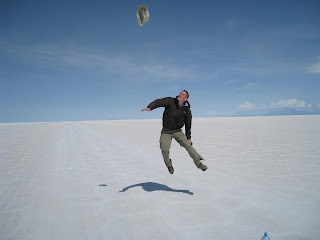
The tour finished on the final day with a 4am start to see the sunrise on the 10,000 sq KM Salt Flats. Originally a lake 40,000 years ago it dried to leave a perfectly flat salt surface. Since it stretches so far there are no trees or rocks to indicate perspective, great for photos, see below!
Next stop was Fish Island. An eerie lonely "island" located in the middle of the flats it provided an opportunity for breakfast, more photos and a lot of very old cactii (most around 1000 years old).
A short drive to the town of Uyuni itself we unloaded the bags and bid farewell to our drivers (we had travelled with another jeep) and checked into the nearest hostel for the night thoroughly exhausted with our sleepless nights and early mornings but not regretting a minute of it.
Next stop Potosi!

Our first stop on the 4x4 tour. It was impossible to take a bad photo of the landscape.

The Toilet Police.

The tree shaped rock

One of the many volcanoes. We need more of these in Ireland.


Catch of the day. Lizzy the Lizard.

Honey I Shrunk the Germans.

Random stupid pose........ NOW!


See ye later hat!

Karen tripping on the Coca.


Everyone together. From left; Brianni, Karen, Aynur, Andreas, Me, Lilly, Nate, Ignassio, Mark.


1/25/09

Vino and Cordoba

The Italians have everything, the weather, fast cars, great food and the best wine. Not only were they happy with keeping it in Italy they came to Argentina to boast some more. Most of the established vineyards in Mendoza were started by Italians and French in the 40s and rival what Europe puts out nowadays.

We rose at the ungodly hour of 8am. Our first experience of the local buses was far from straightforward but we eventually made it to the small town on the edge of Mendoza to rent our bikes; Karen with the girly red one with girly basket, me with the manly one with the manly gears. After about 400m I realised Karen wasn't saying much and looked back to see she was a dot in the distance. Either the lack of gears or extra weight of the plastic basket meant a swap was in order if we were going to make it to the first vineyard before dark. In the end, we reached it around 11am. A suprisingly modern building that looked more like a drug-dealers hideaway sat alongside endless rows of vines 1 month away from harvest. We were greeted with kisses and hugs at the door by the animated owner Christian. He guided us around, told us about his love for the Beatles and urged us to sit and select wines for tasting. After trying 3 of the best wines I've ever tasted we said goodbye and cycled off to visit 3 more vineyards and an olive growing farm. Olives are boring.

By the end of the day we were tired and drunk (well I was, Karen is not a fan of wine and I felt it would seem rude if we didn't polish everything we were offered) and hopped on our Number 10 bus back to the hostel. For some reason, we never figured out, the bus back took twice as long to get back (along a completely different route) that it did getting out but eventually we got back to grab the bags to get our next overnight bus to Cordoba.

Cordoba is boring. Maybe they make olives here, I'm not sure. After struggling around the city centre for 2 hours in the 38C and finding nothing of interest at all we scurried back to the hostel to plan our exit. Some quick internet work allowed us to book a hostel in our next destination a day earlier than planned.

Yesterday was one of the hottest I have ever experienced. The sheer draining relentless-ness of the sun will have you fantasizing about rainy miserable days in Dublin. Its hard to describe how disabling and inescapable the heat can get. A decision was made to do absolutely nothing today and act like vampires not coming out until it was dark. Luckily the Irish gods must have been watching as they sent a spectaular thunderstorm overnight that has knocked temperature down to perfectly chilly 26c, hurray!

Enough waffling, we have a film to watch tonight (The Changeling) and I have more steak to eat.....

EDIT: ok, for some reason the time here is not the same as it is in Mendoza. We've been here 2 days now with our watches set 1 hour behind, wrongly. This all became evident when we walked into a perfectly silent cinema halfway through the film. hmmm. A quick Spanglish discussion with the popcorn boy informed us we were living in the wrong timezone and the film was halfway through. D'oh.
Scurrying away escaping the sniggers behind us we hopped into a lift and punched a random floor. Trying to figure out what to do what to with the rest of our night, the lift doors opened directly into a pub. Ye gotta love those Irish gods....


Karen is glad they never found a way to turn water into wine.


All the grapes are still hand picked. No fancy machinery is used until fermentation. Area52 niche here? :)

nyom nyom nyom! Right, next vineyard please!


1/23/09

Mendoza

Ah steak. Mendoza continues the Argentinian reputation of having the best steaks in the world and then it throws the best wine in too! Mendoza is a city about the size of Dublin. Completely rebuilt in 1861 following an earthquake it is designed in a grid (a common theme in Argentina, great for finding your way around) with mini storm drains running down each side of the road. Despite the weather water continuously runs down these trenches, tapped from a man-made lake outside of town providing irrigation for the vineyards and drinking water. Amazingly ingeniuous they are absolutely LEATHAL walking around. It seems the government gave up covering them long ago and you need to have your wits about you when crossing the road or you're in. I couldn't see it working in Ireland as a small army would be needed to unclog all the drunks from them each morning.

Having only expected to see the famous vineyards in Mendoza it turns out that the city is about 1 hour from the foot of the Andes. Also, due to them being proper mountains, not like the hills we have in Ireland, it means that one minute you're driving through beautiful flat wine-growing fields and then a wall of rock rises before you, 4 miles up. A last minute booking meant we skipped some wine-tasting for some mountain climbing. Of course I mean mountain climbing in the Fat American sense, in a bus, with air conditioning. For the paltry sum of €20 15 of us backpackers were bussed around some of Argentina's slice of the Andes for the whole day (8am to 8pm). Our guide pointed out the peak where the plane crashed with the Uruguayan rugby team from the film Alive. 2 survivors walked for 10 days to get help (ironically in the wrong direction, had they walked east they would have found civilization in 2 days).
We visited some hot springs. Annoyingly closed until the goverment repairs the damage from a landslide we had to be happy with looking and not bathing.
One of last stops on the trip was a small peak that was accessible by bus it marked the border between Chile and Argentina. It was also our first sample of some high altitude. My digital compass told me 3800m but our guide insisted it was lying and it was 4200m... Either way it was high and I could definately feel some of the effects. A little light-headed I was a little disorientated at times and couldn't remember what I wanted to say on occasion. Kind of like Abrakebabra after a night on the town.

So, off to the vineyards tomorrow then off North to Cordoba, our second last stop before Bolivia.

Click me!


This one might be tricky to see. I'll fix the brightness up at some stage when I get access to a laptop.

The surface is like Mars at times, very spooky.

V-shaped valleys. Tectonic plates in action. Thank you 2nd year Geogrpahy.

The sun going down on one of our overnight buses.